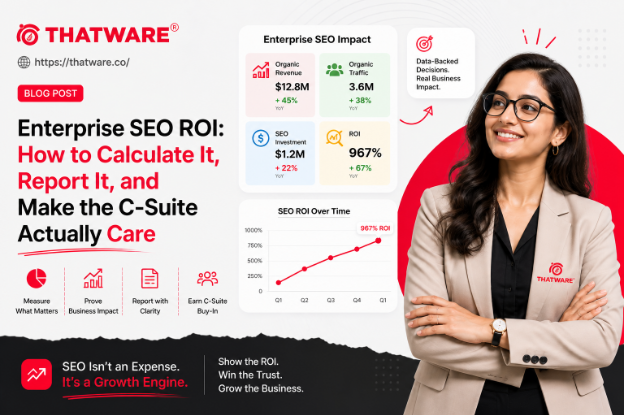
Enterprise SEO programs represent significant investments – often six figures annually or more when you account for agency fees, tool costs, content production, and internal team time. Despite that investment scale, ROI reporting for enterprise SEO is often done poorly: trailing metrics that don’t connect to business outcomes, attribution that overstates SEO’s contribution, or optimistic projections that aren’t grounded in realistic conversion data.
This creates a trust problem. When the C-suite can’t connect the SEO spend to business outcomes, they’re making budget decisions on faith rather than evidence. That’s uncomfortable for them and unstable for the SEO program.
The Attribution Problem in Enterprise SEO
Enterprise SEO attribution is genuinely complex. Organic search typically plays a role in multiple stages of a customer’s journey – awareness, consideration, evaluation – across multiple sessions before a conversion event. Last-click attribution assigns all the credit to the final interaction, which in enterprise B2B is often a direct visit or a paid click after organic has done the early-funnel work.
Enterprise seo services teams that do ROI reporting honestly acknowledge this attribution complexity. They use multi-touch attribution models where available, organic-assisted conversion reporting from Google Analytics 4, and path analysis that shows organic search’s role in the purchase journey even when it’s not the last click.
The data is almost always more favorable to SEO than last-click attribution suggests – because organic search typically drives the awareness and consideration phases that make all subsequent marketing more effective.
Building the ROI Model That C-Suite Leadership Understands
The most effective ROI models for enterprise SEO translate SEO metrics into business financial metrics at every step. Not “organic traffic increased 40%” but “organic traffic increased by 18,000 monthly sessions, of which approximately 2.3% (based on our measured organic conversion rate) represent qualified leads, producing an estimated 414 incremental leads per month at an average closed revenue value of [X], representing [Y] in influenced pipeline.”
Corporate seo services reporting that speaks this language – lead volume, pipeline influence, revenue attribution – gets the C-suite’s attention in a way that session counts and ranking positions don’t. It also enables direct comparison with other marketing channels, which is how budget allocation decisions actually get made.
The Benchmark Comparison That Makes SEO Look Good
Enterprise SEO’s cost structure is genuinely favorable compared to paid channels when looked at correctly. Paid search and paid social have customer acquisition costs that are explicit and immediate: you pay per click or per impression. Organic search has acquisition costs that front-load investment and then produce diminishing cost-per-acquisition over time as content accumulates authority and traffic compounds.
A piece of content that costs $3,000 to produce and earns 500 qualified monthly sessions for three years has a cost-per-session of a fraction of a cent by year three. The equivalent paid traffic at typical B2B CPCs costs orders of magnitude more over the same period. Building a compelling cost-per-acquisition comparison over a 24-36 month horizon is often the most persuasive ROI argument available to enterprise SEO programs.
Reporting Cadence and Format for C-Suite Audiences
The reporting format matters as much as the content. C-suite leadership wants quarterly strategic reviews with business-level metrics, not monthly dashboards full of SEO-specific data. The quarterly review should answer three questions: what did the organic search program contribute to business outcomes this quarter, what are the highest-leverage next quarter priorities, and what does the 12-month trajectory look like based on current performance trends?
Answering those questions clearly and concisely, in business language rather than SEO language, is the skill that determines whether enterprise SEO programs survive budget cycles or get cut at the first sign of macro pressure.
Defending the Budget in a Downturn
When cost reduction pressure hits – as it periodically does in every enterprise – SEO programs that have built clear business ROI evidence are significantly better positioned than programs whose value is expressed in ranking positions and traffic counts. The CFO who understands that the organic search program generates 30% of the qualified pipeline at one-quarter the cost per acquisition of paid channels has a clear reason to protect that budget. The one who sees only SEO metrics doesn’t.
Building that ROI evidence is ongoing work, not a retrospective exercise. Start building the business-outcome attribution model at the beginning of the program, not when budget pressure arrives.